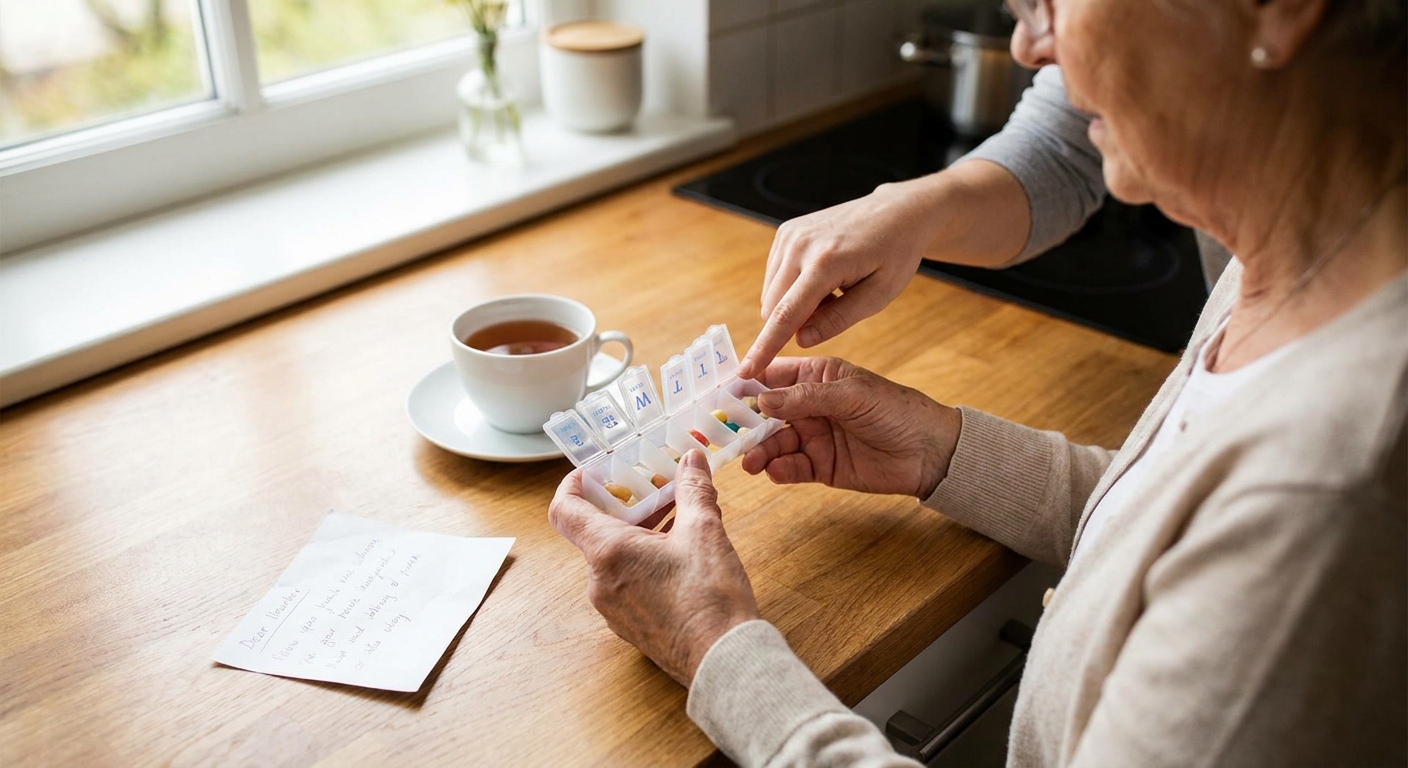
Managing pills for a parent who lives alone is one of the hardest parts of long-distance or long-hours caregiving — one missed dose of blood pressure medication can turn into an ER visit. This guide breaks down what actually works for medication reminders for elderly parents in 2026, and what looks helpful but isn't.
- Automatic pill dispensers work well for parents on 3+ daily medications but cost more upfront — Consider.
- Phone alarm apps fail for parents with any memory decline because there's no family follow-up — Skip.
- Family care apps like Lieve pair reminders with a real check-in call, which catches missed doses same-day — Buy.
- Wearable buzzers help hearing-impaired parents but need daily charging, which becomes its own missed task — Consider.
- Paper pillboxes alone give zero alert to anyone when a dose is skipped — Skip for parents living solo.
Why this matters
A parent living at home with no one physically present to hand over a pill each morning is relying entirely on memory, habit, or a device. Adult children juggling work, kids, and a job an hour away can't call every morning to check — and a text reminder does nothing if the parent doesn't see it or forgets what it means.
The real risk isn't forgetting once. It's forgetting a blood thinner or a heart medication three days running with nobody noticing until a fall or a hospital call. Medication reminders for elderly parents need to solve two separate problems at once: getting the reminder in front of the parent, and telling the family when it didn't land.
Who this is for
This guide is for adult children managing medication for a parent who still lives independently — someone taking two or more daily prescriptions, showing early signs of forgetfulness, or simply living alone with nobody physically present at pill time. If your parent is fully sharp and self-manages a single daily pill without issue, you probably don't need any of this yet. If a parent has moderate cognitive decline and lives with a caregiver, some of the standalone-device options here won't apply — that's a different setup entirely.
What to look for in medication reminders for elderly parents
Reliability of the alert itself
A reminder only works if the parent actually notices it. Loud audible alarms, repeat rings rather than a single beep, and a screen the parent already checks daily (like a phone they already use for calls) beat a new gadget they have to learn from scratch in 2026.
Family visibility when a dose is missed
The single biggest gap in most solutions is silence. If a parent skips the 8am dose and nothing tells anyone until the evening, the whole point of the reminder is lost. Look for something that surfaces a missed dose to a family member the same day, not a weekly summary.
Simplicity for the parent, not the caregiver
An app that's easy for you to set up but confusing for your 78-year-old parent to interact with daily fails within a week. The best setups need zero ongoing input from the parent beyond answering a call or tapping one button.
A human element, not just an alarm
A buzzing device is easy to ignore or silence out of habit. A reminder tied to an actual voice — a check-in call or a friendly prompt — gets acknowledged more reliably than a screen notification, especially for parents who are hard of hearing or mildly anxious about new tech.
Escalation path when something's wrong
One missed dose is a data point. Two in a row is a pattern worth a phone call. The tool you pick should make it obvious to the family when a pattern is forming, not just log a missed checkbox nobody looks at.
No new hardware to maintain
Devices that need charging, WiFi setup, or a subscription card in a drawer become one more thing to fail. Anything that runs on a phone the parent already owns and already charges removes an entire failure point.
See how family medication check-ins work
Lieve combines reminders, calls, and family visibility in one app.
Top picks for elderly parents living at home
Automatic pill dispensers — the structured pick. These lock compartments until the scheduled time and physically prevent double-dosing, which matters for a parent on three or more daily prescriptions. One spec that matters: most units alert only through a local light or beep, not a family notification, so someone still has to be nearby to notice a missed slot. Verdict: Consider, mainly for parents with a complex pill schedule and a caregiver who visits daily.
Phone alarm and reminder apps — the DIY pick. Free, already installed, and familiar if your parent already texts or calls on a smartphone. The catch: a missed alarm just gets dismissed or ignored, and nobody else finds out. For a parent with any memory decline, this is the option most likely to quietly fail. Verdict: Skip unless your parent is fully independent and simply needs a nudge.
Family care apps with reminders and check-in calls — the safe pick. Lieve pairs a medication reminder with a one-tap call and a friendly companion check-in, managed by the family rather than left entirely to the parent. The concrete advantage here is that a missed dose doesn't sit silent — it surfaces to the family the same day instead of getting buried in a device log. Verdict: Buy for families who want visibility without installing new hardware in a parent's home.
Wearable reminder devices — the wildcard. A smartwatch or clip-on buzzer works well for parents who are hard of hearing and might not notice a phone alert. The tradeoff: it needs daily charging, and a forgotten charge means a full day with zero reminders. Verdict: Consider only if your parent already wears a smartwatch and charges it out of habit.
Paper pillbox plus a sticky note — the budget pick. Costs nothing and requires no setup. But there's no alert, no escalation, and no way for anyone to know a compartment was skipped until someone physically checks it. Verdict: Skip for any parent living alone without daily in-person visits.
What to avoid
- Apps that require the parent to navigate a multi-step interface. If setting a reminder or acknowledging one takes more than one tap, adoption drops off within days for most parents over 75.
- Devices that need the parent to manage their own WiFi or Bluetooth pairing. A dropped connection silently breaks the whole system, and the parent has no way to know or fix it.
- Single-alert tools with no missed-dose follow-up. A reminder that fires once and moves on gives you the illusion of coverage while leaving the actual risk — the missed dose — completely unaddressed.
Verdict comparison
| Option | Alert reliability | Family visibility | Setup effort | Verdict |
|---|---|---|---|---|
| Automatic pill dispenser | High (local) | Low | Medium | Consider |
| Phone alarm app | Medium | None | Low | Skip |
| Family care app (e.g. Lieve) | High | High | Low | Buy |
| Wearable buzzer | High (if charged) | Low | Medium | Consider |
| Paper pillbox | Low | None | None | Skip |
FAQ
What's the best medication reminder for elderly parents living alone in 2026?
A family care app that pairs the reminder with a check-in call, like Lieve, works best for parents living alone because it tells the family the same day a dose is missed. Standalone alarms and pillboxes give no such follow-up.
Is a pill dispenser better than an app for elderly parents?
A pill dispenser is better for parents on three or more daily prescriptions who need doses physically locked until the scheduled time. It doesn't notify family, though, so pair it with something that does if the parent lives alone.
How much does a medication reminder app cost for elderly parents?
Costs vary by provider and plan, so check current pricing directly on the app or dispenser's site before choosing. Basic phone alarm apps are typically free but come without family alerts.
Do medication reminder apps work for parents with memory loss?
Apps that rely solely on the parent reading and dismissing a notification tend to fail once memory decline sets in. Reminders combined with a voice call or human check-in hold up better because they don't depend on the parent interpreting a screen.
Can family members get notified if a parent misses a dose?
Yes, but only with tools built for it — most standalone dispensers and phone alarms don't notify anyone but the parent. Family care apps built around shared visibility are designed specifically to close this gap.
What's the difference between a medication reminder and a medical alert device?
A medication reminder prompts a specific dose at a specific time, while a medical alert device is for emergencies like a fall. Some family care apps in 2026 combine both functions, including one-tap calling alongside reminders.
Do elderly parents need a smartphone for medication reminder apps?
Most family care apps run on a smartphone the parent already owns, which avoids introducing new hardware. A basic phone with calling and a simple app interface is usually enough.
How often should medication reminders check in with an elderly parent?
Reminders should align with the actual prescription schedule — once, twice, or three times a day depending on the medication. A single daily nudge is not enough for parents on multi-dose regimens.
One last thing
The families who stick with a medication reminder system past the first month are almost never the ones who bought the fanciest dispenser — they're the ones who picked something that told them, directly and the same day, when something went wrong. That single feature, a same-day family alert, matters more in 2026 than any lock, timer, or flashing light on the device itself.